
Minnesota DNR Announces Major Changes to Snowmobile GIA Funding
MINNESOTA SNOWMOBILE GIA PROGRAM
Executive Summary of Proposed Changes for the 2026–2027 Season
Background
The Snowmobile Grant-In-Aid (GIA) program was first established in 1973 to help support the development, maintenance, and grooming of locally initiated snowmobile trails. GIA grants are awarded to local units of government who often act as sponsors for clubs that do the trail work. How GIA grants have been administered has changed over the years. Originally the program was set up as a reimbursement-based cost share, meaning the sponsors and clubs were reimbursed at a percentage of eligible expenditures.
The GIA program’s last significant update was in 2007 when the GIA model shifted from providing reimbursement-based grants to performance-based grants. The performance-based grant model helped improve administrative efficiency and reduced grantee paperwork, which worked well during years of consistent statewide snowfall. However, Minnesota has recently experienced multiple winters of low to no snow. This has resulted in inconsistent funding availability for the program and an inability to adequately support all trail miles through the state. In addition, the State of Minnesota has undertaken efforts to improve grant accountability and ensure that grant programs have strong procedures in place for fraud prevention.
Snowmobile GIA Program Improvement Values
- Prioritize snowmobilers – Invest snowmobile registration and gas tax revenue in the most effective way, to provide the highest benefit to snowmobilers in Minnesota.
- Accountability – Ensure fund integrity and reduce the risk of fraud or misuse of funds.
- Adaptability – Ensure an adaptable system so snowmobile trails have adequate funding when and where needed.
- Sustainability – Ensure long-term sustainability of the snowmobile program.
GIA Improvement Process Summary
DNR convened a Snowmobile GIA Improvement Workgroup, made up of 15 people with experience and perspectives in snowmobile trail maintenance, grooming operations, grant management, and the current GIA Program. Workgroup members included snowmobile club members (including both local clubs and the Minnesota United Snowmobilers Association), trail administrators, local unit of government representatives (including a representative from the Minnesota Association of County Land Commissioners), and DNR staff. Members were selected to provide a geographic representation of Minnesota, including members from all DNR regions. The workgroup goals, founded on the above improvement values, were to ensure the long-term sustainability of the Minnesota Snowmobile GIA Program and to establish a hybrid grant model. The workgroup met monthly for 5 months from May to September 2026 and came to a consensus recommendation on improvements to the GIA program.
Overview
- DNR is making improvements to the Snowmobile GIA Program to reduce the risk of fraud, better adapt to unpredictable weather conditions, and ensure long-term financial sustainability.
- DNR convened a 15 members Snowmobile GIA Improvement Workgroup, which met monthly for 5 months from May to September 2026 and came to a consensus recommendation on improvements to the GIA program.
- The GIA program improvements include transitioning to a new hybrid GIA model. The hybrid model will:
- Balance the efficiency of a performance-based model with the accountability of a reimbursement-based model.
- Promote consistency and fairness in how grants are funded for trail setup and closure.
- Ensure sufficient funding is available for grooming reimbursement when and where needed.
- While the DNR has an important role implementing the new changes in grant administration, the deliverables are accomplished by local sponsors and clubs in the snowmobile GIA program.
New Hybrid GIA Plan Characteristics
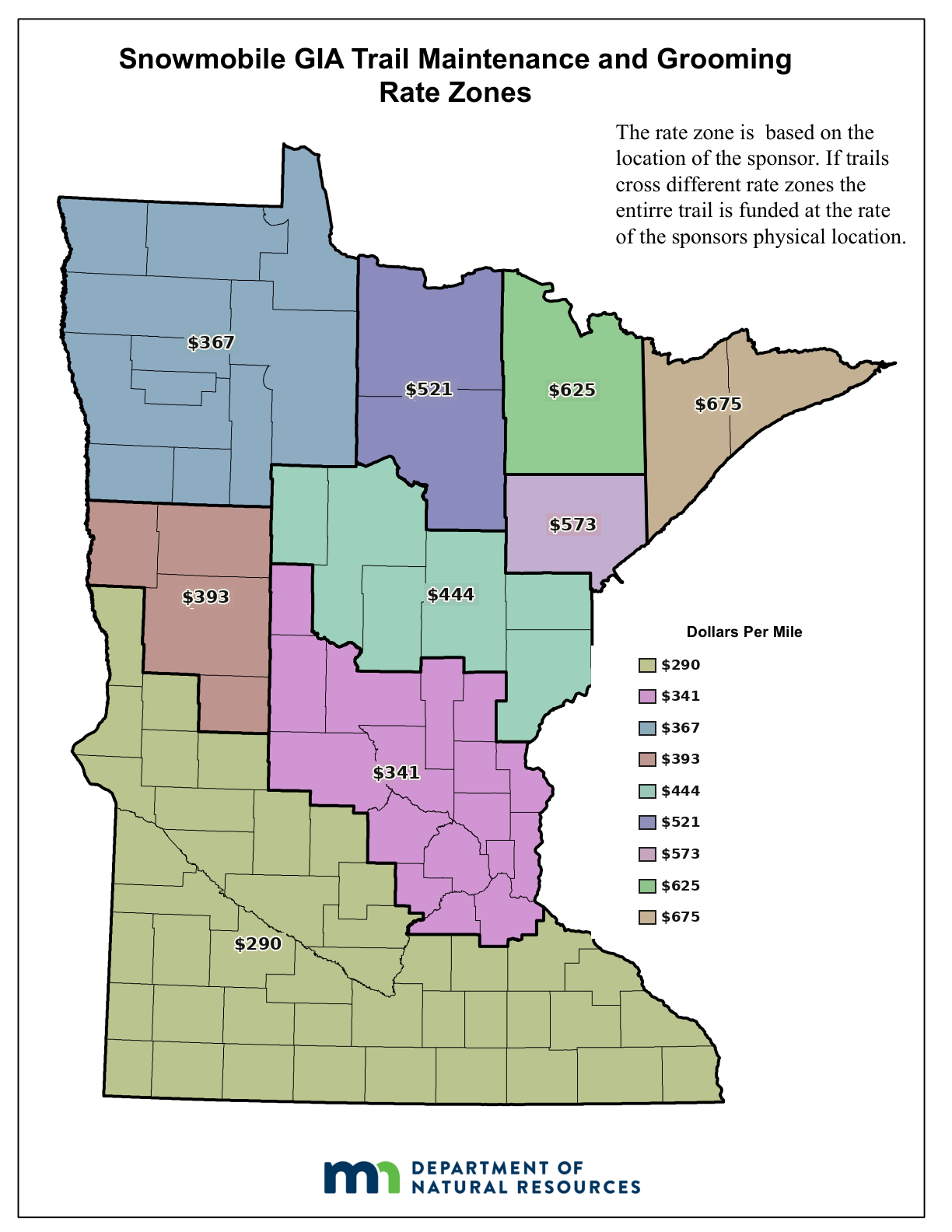
- Total grant amounts will continue to be calculated using the Rate Zone map.
- All Rate Zones will be increased by 10% beginning fiscal year (FY) 2027.
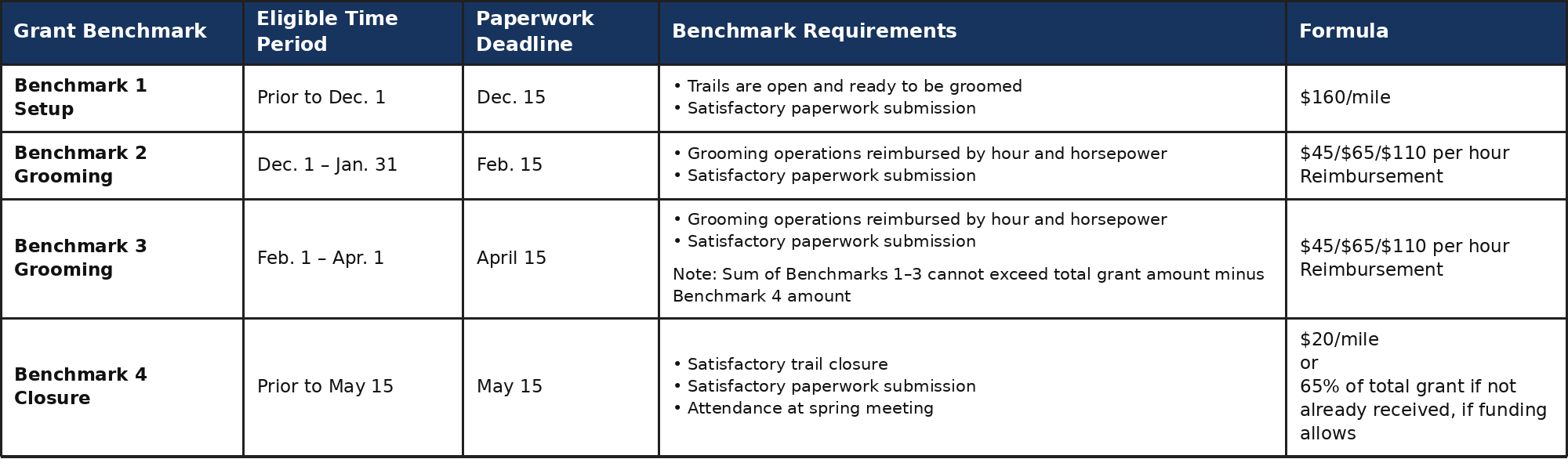
- Benchmark 1 is calculated at $160 per GIA mile for all grants. Funding is awarded for successful set-up of GIA trails by December 1st annually.
- Benchmarks 2 and 3 are earned through eligible grooming operations.
- For Benchmark 2, the grooming logs and the request for reimbursement forms, which summarize all grooming operations between 12/1 and 1/31, must be submitted by February 15th.
- For Benchmark 3, the grooming logs and the request for reimbursement forms, which summarize all grooming operations between 2/1 and 4/1, must be submitted by April 15th.
- Reimbursements for Benchmarks 2 and 3 are calculated using the following rates:
- $45 per hour for all snow packing conducted without an attachment no matter the size.
- $45 per hour for all grooming activities conducted with a snowmobile or tracked ATV with grooming attachments (tracked ATV is less than or equal to 80 horsepower). All snowmobiles are included under this rate, no matter the size.
- $65 per hour for all grooming activities conducted with a midsized, tracked vehicle with grooming attachments (tracked vehicle greater than 80 horsepower and up to 150 horsepower).
- $110 per hour for all grooming activities conducted with a large, tracked vehicle with grooming attachments (equipment or tracked vehicle greater than 150 horsepower).
- Benchmark 4 is calculated at $20 per GIA mile for all grants. If funding allows, grantees that have not already received 65% of their total grant amount may request the difference in lieu of $20 per GIA mile.
- Trail Improvement Grants and Supplements will be considered annually contingent on available funding and demonstrated need.
- Any unexpected GIA funding savings will be reinvested into the Snowmobile GIA program in a manner that provides the highest benefit to snowmobilers in Minnesota.
Table 1: Snowmobile GIA Benchmark Overview
Stewardship of GIA Funds
Grantees are expected to use the most effective and appropriately sized equipment available to them for the given grooming task. Submitting inaccurate grooming reimbursement requests or using a larger than necessary vehicle for a given task does not demonstrate good stewardship of GIA funds and may not be eligible for reimbursement based on misuse of funds. Deliberately falsifying grooming reimbursement requests is fraud.
Updated Rate Zone Map
Effective beginning in the 2026–2027 season, an updated Snowmobile GIA Rate Zone map will be used to determine the total eligible grant amount for each grant. The updated map below reflects a 10% increase for all rate zones compared to the 2025–2026 season.
Next Steps
The new GIA program changes are being finalized for this winter season. DNR Area Supervisors will communicate with sponsors & clubs about the proposed changes. The updated GIA manual, forms and contracts are anticipated to be ready in mid-November with the goal of full implementation and compliance by December 1, 2026.